

Wireless networks are entering a new era.
For decades, communications infrastructure has been built to move data from one place to another. Faster connections. Lower latency. More capacity. Better coverage. But as AI moves closer to the edge, and as wireless systems become more software-defined, the role of the network is beginning to expand.
The network is no longer just a communications layer.
It is becoming a sensing layer. A compute layer. An intelligence layer.
That shift was on full display at NVIDIA GTC DC, where conversations around accelerated computing, edge AI, AI-RAN, and physical AI all pointed toward the same future: intelligent infrastructure that can understand, interpret, and respond to the physical world in real time.
For Tiami Networks, that future is directly connected to Integrated Sensing and Communications, or ISAC.
From Connectivity to Perception
Integrated Sensing and Communications is the idea that wireless systems can do more than transmit information. The same RF signals used for 4G and 5G connectivity can also be used to detect motion, track objects, monitor environments, and generate real-time situational awareness.
Instead of relying only on dedicated sensors such as cameras, lidar, or traditional radar, ISAC allows communications infrastructure and RF signals of opportunity to become part of the sensing fabric.
That matters because many of the environments that need better awareness are also the environments where conventional sensing is difficult.
Cameras can be limited by darkness, weather, line of sight, and privacy concerns. Active radar can add emissions in places where low observability matters. RF command-and-control detection can miss drones that are pre-programmed, fiber-controlled, or operating with reduced emissions.
ISAC offers a different path.
It uses the wireless environment itself as a source of intelligence.
What Is Integrated Sensing and Communications?
Integrated Sensing and Communications, or ISAC, is an emerging wireless technology approach that uses communications infrastructure and RF signals for both data transmission and environmental sensing. Instead of relying only on dedicated sensors, ISAC allows wireless systems to detect, track, and interpret activity in the physical world using existing 4G, 5G, and future 6G networks.
In short: edge AI makes ISAC practical by allowing RF sensing data to be processed close to the source, enabling low-latency detection, classification, and situational awareness without relying entirely on cloud connectivity.
Why Edge AI Matters for RF Sensing
Sensing with RF is not simply a matter of collecting signal data. The real value comes from interpreting subtle changes in the wireless environment and turning those changes into actionable insight.
That is where edge machine learning becomes essential.
RF sensing data can be complex, noisy, and highly dynamic. In many use cases, the system cannot wait for data to be moved to a distant cloud, processed, and returned. Drone detection, perimeter awareness, tactical operations, smart infrastructure, and public safety applications all require low-latency inference close to the source.
Edge ML enables that.
By running models near the sensor, or directly inside the network infrastructure itself, ISAC systems can support real-time classification, tracking, and decision support while reducing bandwidth requirements and improving operational resilience.
This is also why NVIDIA’s role in the future of telecom is so important. NVIDIA has helped define the accelerated computing foundation for modern AI, and that same foundation is now moving into the radio access network through AI-RAN. As telecom networks become more AI-native, platforms such as NVIDIA AI Aerial point toward a future where communications, compute, and AI inference are increasingly integrated at the edge.
PolyEdge: Passive RF Sensing at the Edge
Tiami’s PolyEdge platform is designed for non-cooperative ISAC.
That means PolyEdge does not require changes to the network it is sensing. It can use existing 4G and 5G signals of opportunity to help detect and track activity in the surrounding environment without transmitting its own radar waveform.
This is especially important for defense, public safety, critical infrastructure, and other environments where passive sensing provides an operational advantage.
PolyEdge can support use cases such as:
- RF-silent drone detection
- Perimeter and base awareness
- Vehicle and pedestrian detection
- Smart infrastructure monitoring
- Camera-free occupancy sensing
- Low probability of geolocation sensing operations
Because PolyEdge is built around edge intelligence, it can support real-time inference in environments where bandwidth, latency, privacy, or connectivity constraints make cloud-first architectures impractical.
In some deployments, lightweight models can run directly at the edge. In others, PolyEdge can support hybrid workflows where edge processing is combined with cloud-based characterization and model improvement.
The result is a flexible sensing architecture that can bring RF intelligence to environments where conventional sensors are limited.
PolyRAN: Bringing Sensing Into the Network
PolyEdge enables rapid sensing without modifying the network.
PolyRAN extends the vision further by embedding sensing capabilities into the radio access network itself.
This is the cooperative ISAC model: instead of deploying standalone sensors around the network, the network becomes the sensor.
With PolyRAN, sensing logic can operate inside the RAN, allowing base stations and network infrastructure to participate directly in environmental awareness. This creates a path toward scalable, network-native sensing for telecom operators, defense users, smart cities, airports, and critical infrastructure.
Tiami demonstrated this direction at MWC Barcelona 2025 through work with the AI-RAN Alliance, showing how ISAC can move from standalone non-cooperative sensing toward cooperative sensing embedded inside AI-native network infrastructure.
That evolution aligns closely with NVIDIA’s broader AI-RAN vision.
As AI-RAN matures, the RAN becomes more than a connectivity platform. It becomes an edge AI platform capable of running communications workloads, sensing workloads, and inference workloads on accelerated infrastructure.
For ISAC, that is a major unlock.
It means sensing can scale across the same distributed infrastructure already being built for 5G, 6G, and edge AI.
GTC DC and the Future of RF Intelligence
NVIDIA GTC DC reinforced a theme that is becoming increasingly clear across both AI and telecom: the next generation of infrastructure will be intelligent, distributed, and physically aware.
For Tiami, that message connects directly to our work in RF intelligence.
The future is not simply about adding more sensors. It is about making better use of the signals, infrastructure, and compute already present in the environment.
That future requires several technologies to converge:
- 4G and 5G signals of opportunity
- Edge machine learning
- Accelerated computing
- AI-native RAN infrastructure
- Software-defined sensing
- Real-time RF intelligence
This convergence is what makes ISAC so powerful.
It allows networks to detect, classify, and understand activity in the physical world while continuing to serve their primary communications function. It creates new possibilities for defense, security, mobility, infrastructure, and public safety. And it opens a path toward wireless systems that do not just connect devices, but perceive the environment around them.
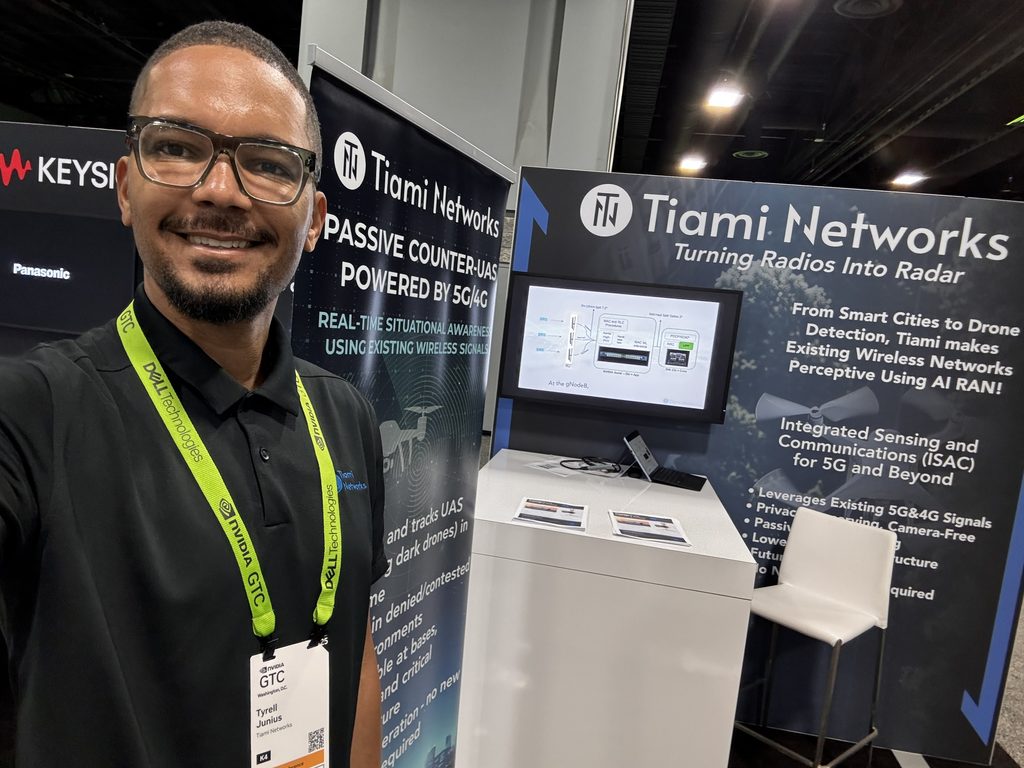
The Network as a Sensor
The long-term direction is clear.
Wireless networks are becoming intelligent platforms.
With PolyEdge, Tiami enables passive, non-cooperative sensing using existing 4G and 5G signals. With PolyRAN, Tiami brings sensing directly into the network, helping turn communications infrastructure into distributed RF intelligence.
NVIDIA’s accelerated computing and AI-RAN ecosystem provide an important foundation for this shift. As AI moves closer to the edge and telecom networks become more software-defined, ISAC will become a critical part of how networks create value beyond connectivity.
The network of the future will not simply move data.
It will understand the physical world. And that future is already taking shape.


