
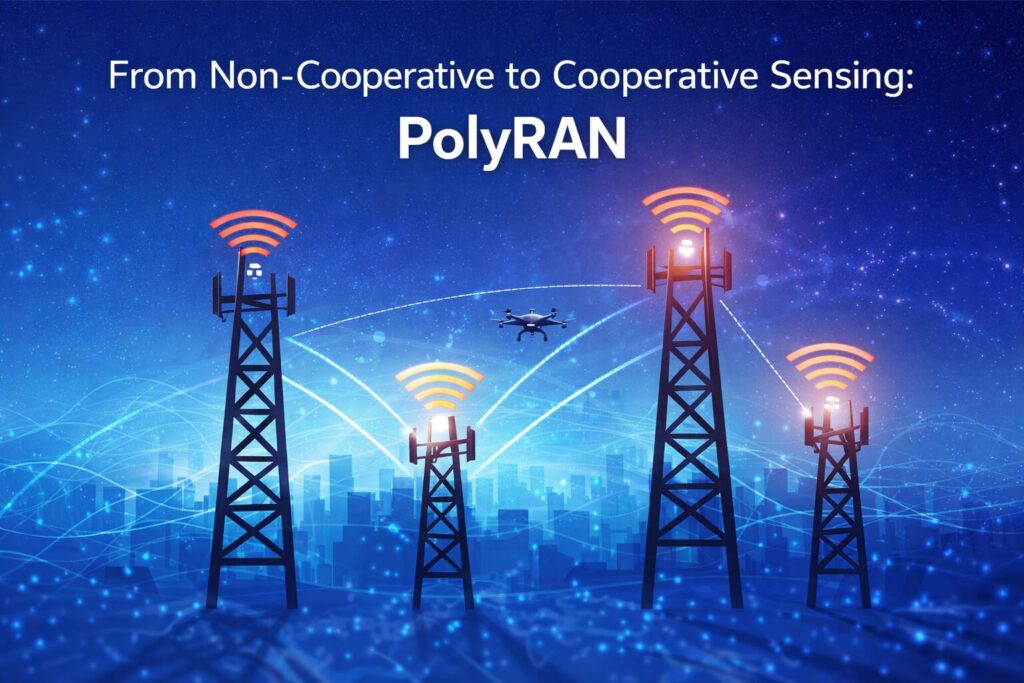
The Evolution of Sensing in Wireless Networks
Wireless networks were never designed to sense the world around them. Their purpose was simple: transmit data from point A to point B.
That is changing.
Integrated Sensing and Communications (ISAC) is redefining wireless infrastructure by enabling networks to function as both communication systems and sensing platforms. Instead of deploying dedicated radar or camera systems, the network itself becomes the sensor.
This shift is already underway through non-cooperative sensing, where systems passively analyze ambient 4G and 5G signals to detect objects and activity.
But this is only the first step.
The real breakthrough comes with cooperative sensing, where the network operates as a unified sensing system. This is the foundation of PolyRAN.
What Is Non-Cooperative Sensing?
Non-cooperative sensing uses existing wireless signals without modifying the network. It relies on ambient transmissions, often referred to as signals of opportunity, to detect and track objects.
In this model:
- A sensing node like PolyEdge™ listens to 4G or 5G signals in the environment
- It analyzes reflections from objects like drones, vehicles, or people
- It extracts insights using signal processing techniques and proprietary machine learning algorithms
This approach enables:
- Drone detection without emitting signals, including RF-silent targets
- UAV detection and UAS detection in contested environments
- RF sensing and radio sensing without dedicated radar infrastructure
Non-cooperative ISAC is powerful because it is:
- Fast to deploy
- Cost-effective
- Stealthy
It allows organizations to implement drone detection systems and counter drone systems without adding new transmitters or spectrum requirements.
The Limitations of Non-Cooperative ISAC
Despite its advantages, non-cooperative sensing has inherent limitations.
Each sensing node operates independently. That means:
- Limited coverage per node
- Need for multiple nodes to cover larger areas
- Reduced accuracy in complex or cluttered environments
Each sensor sees only a fragment of the environment.
In high-density areas or mission-critical scenarios, this lack of coordination becomes a constraint. Detection performance, localization accuracy, and overall situational awareness are all limited by the fact that sensing is not shared across the network.
To move beyond this, sensing must evolve from isolated nodes to coordinated systems.
What Is Cooperative Sensing?
Cooperative sensing transforms individual sensing nodes into a unified system.
Instead of operating independently, multiple base stations work together to:
- Share sensing data
- Fuse signal reflections
- Build a collective understanding of the environment
This is the core idea behind cooperative ISAC.
Rather than each node acting alone, the network collaborates.
PolyRAN: Cooperative ISAC at Network Scale
PolyRAN extends sensing from the edge to the entire radio access network.

Caption: Cooperative ISAC architecture using PolyRAN with Vodafone’s network, where distributed units and radio units enable network-wide sensing and real-time KPI analysis.
By enabling coordination between base stations, it turns the network into a distributed sensing platform capable of delivering network-wide awareness.
With PolyRAN:
- Multiple cells contribute to detection and tracking
- Signal reflections are fused across the network
- Sensing performance improves through spatial diversity
This fundamentally changes what wireless sensing can achieve.
From Local Detection to Network Awareness
The difference between non-cooperative and cooperative sensing is not incremental. It is transformational.
Non-cooperative sensing:
- Localized detection
- Independent nodes
- Limited spatial awareness
Cooperative sensing with PolyRAN:
- Network-wide coverage
- Shared intelligence
- Enhanced detection accuracy
Instead of one sensor making a decision, the network works together to interpret the environment.
Why Cooperative Sensing Matters
1. Network-Wide Coverage
Cooperative sensing expands detection from a single node to the entire network footprint.
This enables:
- Large-scale drone detection systems
- Persistent monitoring across wide geographic areas
- Scalable wireless sensing infrastructure
2. Improved Detection of RF-Silent Targets
By combining observations from multiple base stations, cooperative systems can detect objects that may be invisible to a single node.
This is especially important for:
- RF drone detection
- Autonomous systems with no active emissions
- Low-signature aerial threats
3. Increased Accuracy Through Sensor Fusion
When multiple nodes observe the same object from different perspectives, accuracy improves.
This leads to:
- Better localization of targets
- More reliable tracking
- Reduced false positives
4. Alignment with the Future of Wireless Networks
Cooperative sensing aligns with the evolution toward:
- 6G networks
- Open and programmable RAN architectures
- Distributed intelligence across the network
Sensing becomes a native capability of the infrastructure, not an add-on.
Real-World Applications
The shift to cooperative ISAC unlocks a wide range of applications.
Defense and Security
- Counter drone systems for contested environments
- Persistent UAS detection across large areas
- Airspace and perimeter monitoring
Smart Infrastructure
- Traffic flow analysis
- Crowd density monitoring
- Urban planning and smart city optimization
Critical Environments
- Airport and airspace security
- Border monitoring
- Large-scale event protection
These applications all benefit from moving beyond isolated sensing toward coordinated, network-level awareness.
From Edge Sensing to Network Intelligence
The evolution of ISAC can be understood in two stages.
Stage 1: Non-Cooperative Sensing
- Passive
- Edge-based
- Rapid deployment
Stage 2: Cooperative Sensing
- Coordinated
- Network-integrated
- Scalable
PolyRAN represents the transition to this second stage.
It enables the network to function as a unified sensing system rather than a collection of independent sensors.
The Future of ISAC
Wireless networks are evolving beyond communication.
They are becoming:
- Distributed sensing platforms
- Sources of real-time environmental intelligence
- Foundational infrastructure for security and situational awareness
The move from non-cooperative to cooperative sensing is a key step in that evolution.
Final Thoughts
Non-cooperative sensing proved that wireless networks can detect and interpret the world around them.
Cooperative sensing shows how far that capability can scale.
With PolyRAN, sensing is no longer limited to individual nodes. It becomes a shared, network-wide capability.
From isolated detection to coordinated awareness, this is the next phase of integrated sensing and communications.


