

Every major shift in technology starts the same way: a change in architecture. Today, that shift is happening in drone detection systems and counter drone systems, driven by advances in RF sensing and integrated sensing and communications (ISAC).
Before smartphones, no one expected a single device to replace cameras, GPS systems, music players, and entire categories of consumer electronics. But once the architecture evolved, cost curves collapsed and entirely new markets emerged.
We believe the same kind of shift is coming to drone detection systems and counter drone systems.
At Tiami Networks, we’ve been asking a simple but important question:
What would it take for a capable cUAS sensor to cost under $1,000?
This is not what exists today. But it is a future grounded in real advances in RF sensing, integrated sensing and communications (ISAC), and network-native architectures that we are already proving in the field.
The Asymmetry Driving cUAS Innovation
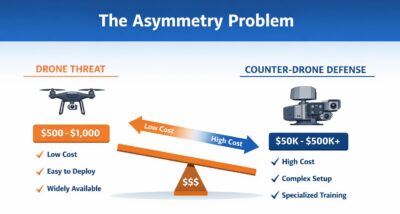
Today’s UAS detection problem is fundamentally economically asymmetric.
A small drone is:
- inexpensive
- widely accessible
- easy to deploy
The systems designed for drone detection and drone defense systems are often:
- expensive
- complex
- infrastructure-heavy
This creates a mismatch where a low-cost threat requires a high-cost response.
Closing that gap is one of the most important challenges in modern counter drone systems.
The answer is not incremental cost reduction.
It requires rethinking how sensing itself is done.
From Hardware-Centric to Network-Native Sensing
Traditional RF drone detection systems rely on:
- high-gain antennas
- active radar transmissions
- multi-sensor fusion stacks
- significant compute infrastructure
These architectures inherently drive cost.
A sub-$1000 sensor will not emerge from optimizing these systems. It will emerge from replacing them.
The shift is already underway.

The Architectural Shift Behind Low-Cost UAV Detection
1. Turning the RF Environment into the Sensor
Instead of relying on purpose-built hardware, next-generation systems treat the ambient RF environment as the sensing medium.
Buildings, reflections, and existing signals become part of the sensing fabric.
This is the foundation of modern RF sensing.
2. Leveraging Existing 4G and 5G Signals
With integrated sensing and communications (ISAC), cellular networks become both communication infrastructure and sensing infrastructure.
In the United States alone, there are hundreds of thousands of cellular sites, including a dense mix of macro towers and small cells, creating a pervasive RF environment across urban, suburban, and many rural areas.
This enables:
- passive UAV detection
- no additional spectrum
- no dedicated transmitters
The sensor no longer needs to generate its own waveform — it uses what already exists.
3. Moving Precision into Software
Advances in:
- machine learning
- edge AI
- signal processing
allow extraction of micro-Doppler and motion features from complex environments without traditional radar hardware.
Precision shifts from hardware to software.
4. Converging on Commodity Hardware
As edge compute becomes cheaper, sensing systems can be built on:
- low-cost silicon
- software-defined architectures
- cloud-connected processing
This is how cost curves collapse.
What Tiami Is Proving Today
We are not building a $999 sensor today.
What we are deploying today, however, already proves the architecture required to get there.
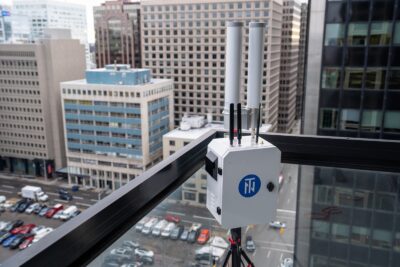
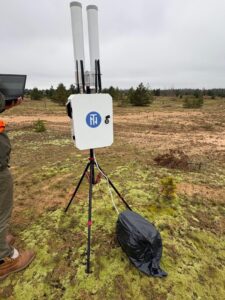
Our systems are operational today, delivering real-world drone detection using passive RF sensing and integrated sensing and communications (ISAC) across multiple environments.
Today, we are demonstrating:
- Passive drone detection using existing 4G and 5G signals
- Detection of RF-silent drones using integrated sensing and communications (ISAC)
- Complementary approaches to RF drone detection when command-and-control links are present
- High-performance sensing without large antennas or heavy infrastructure
Across pilots and deployments, we are showing that effective UAS detection does not require legacy radar architectures.
Each engagement helps validate a new model — one where sensing is:
- distributed
- software-defined
- network-native
The Future of Scalable Counter Drone Systems
Now imagine the implications.
Instead of deploying a handful of high-cost systems, organizations could deploy drone detection systems at scale:
- airports
- stadiums
- military bases
- border infrastructure
- critical energy sites
- smart cities
Coverage becomes ubiquitous.
Not because threats increase — but because cost barriers disappear.
A New Cost Curve for Drone Defense Systems
The path to a $999 sensor is not about cutting features.
It is about changing the architecture of sensing itself.
Just as smartphones redefined computing, ISAC-driven RF sensing is redefining counter drone systems.
Smaller
Smarter
Network-aware
Software-defined
Mass deployable
That is the direction the industry is moving.
And that is the future we are building toward.
Learn more about our integrated sensing and communications (ISAC) approach HERE.


