
As wireless networks evolve beyond connectivity into intelligent infrastructure, Integrated Sensing and Communications (ISAC) has emerged as a critical technology pillar. By using the same waveforms and infrastructure to both transmit data and sense the environment, ISAC transforms traditional communications networks into multifunctional platforms capable of enabling everything from smart cities to autonomous systems. ISAC is emerging as the linchpin for secure, intelligent infrastructure in an era of adversarial threats, dense urbanization, and automated mobility.
Why ISAC Matters Across Industries
As Integrated Sensing and Communications (ISAC) moves from concept to deployment, its value is being recognized across multiple sectors – not just for what it enables technically, but for the operational and strategic advantages it brings.
For Telecom Operators: ISAC reduces both capital and operating expenses by combining sensing and communications on shared infrastructure. Instead of deploying separate radar or camera systems, telcos can use their existing 5G networks to monitor environments, detect anomalies, and gather real-time insights. This convergence lowers deployment costs (CAPEX), streamlines network maintenance (OPEX), and opens the door to new sensing-as-a-service revenue models.
For the Public Sector: ISAC enhances situational awareness by enabling passive, real-time monitoring of people, vehicles, and drones – even in GPS-denied or low-visibility environments. Governments and agencies can leverage commercial wireless infrastructure to improve surveillance and safety, especially in applications like border security, emergency response, and critical infrastructure protection.
For Automotive OEMs: ISAC complements onboard vehicle sensors by providing environmental awareness beyond line-of-sight – detecting objects through occlusions and providing context via the network itself. This additional sensing layer supports safer autonomous driving and more robust ADAS (Advanced Driver Assistance Systems), especially in complex urban environments where traditional sensors alone may struggle.
In short, ISAC isn’t just a technical upgrade – it’s a strategic enabler for cost savings, safety, and innovation. But where exactly does ISAC stand in the formal wireless standards today? And how close are we to mainstream deployment?
ISAC in 5G and 5G Advanced
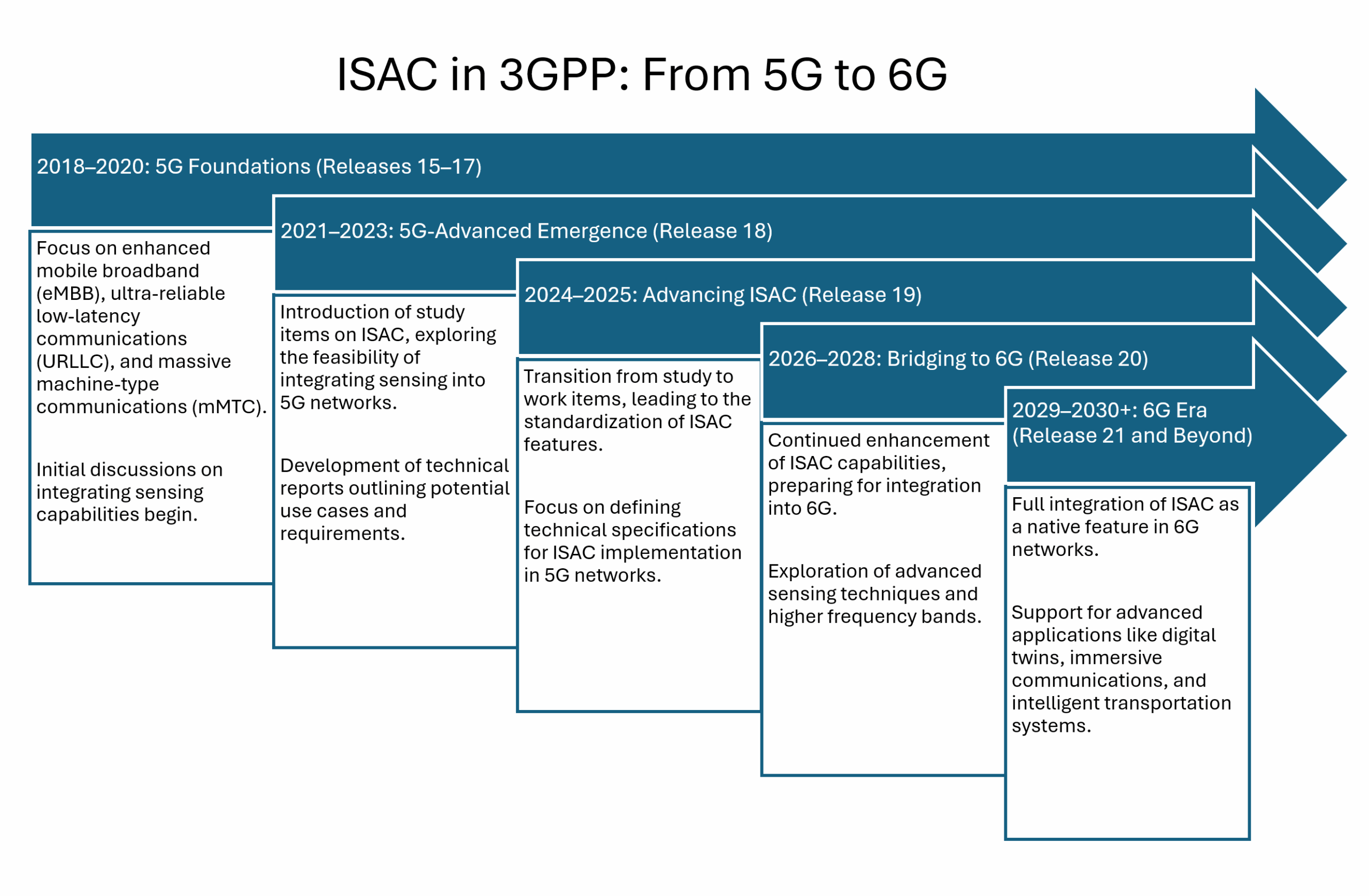
While early 5G rollouts focused largely on enhanced mobile broadband and low-latency applications, the concept of integrating sensing capabilities into the network has steadily gained traction. The 3rd Generation Partnership Project (3GPP), which defines global wireless standards, in Release 18, initiated a Study Item on Radio-based Positioning Enhancements, setting the stage for advanced localization without dependency on the global navigation satellite system (GNSS) for 5G-Advanced.
In Release 19, now in progress, ISAC is gaining sharper focus. The 3GPP Service & System Aspects Work Group 1 (SA WG1) published a technical report and a specification covering ISAC use cases, including 32 use cases, and requirements.
Topics under discussion include:
• Deployment scenarios, including target classification and communication environment
• Channel modeling
The work remains in the study phase, but the foundation is being laid for future Work Items that would formally define ISAC features in later releases, likely timed with the transition toward 6G.
Looking Ahead to 6G
European Telecommunication Standard Institute (ETSI) Industry Specification Group (ISG) ISAC leads pre-standardization work aimed at advancing ISAC for 6G systems. The group is developing a roadmap focused on sensing use cases that extend beyond what is addressed in 3GPP Release 19, identifying those with the potential to influence future 6G deliverables from standardization bodies such as 3GPP, IEEE, and International Telecommunication Union-Radiocommunication Sector (ITU-R). A key activity is the development and validation of advanced radio channel models suited to both communications and sensing, including measurement campaigns and modeling of stochastic and deterministic scattering. In parallel, ISG ISAC is defining key performance indicators (KPIs) and their evaluation methods.
The group is also studying required architectural changes at both the system and radio access network (RAN) levels to support different levels of integration between sensing and communication, various sensing types such as monostatic or multistatic, deployment modes including downlink, uplink, and diverse node types such as TRPs, UEs, and non-3GPP devices.
The vision for 6G includes ISAC as a native capability. Industry roadmaps from major research alliances, such as the Next G Alliance in North America and Hexa-X in Europe, highlight joint communication and sensing as a cornerstone of 6G’s value proposition.
Anticipated features include:
• Centimeter-level accuracy for localization
• Sensing-aware network scheduling
• Radar-like capabilities integrated into base stations
The timeline for 6G standardization points to early 2030s deployments, with ongoing pre-standard research through the rest of this decade. What’s happening now, in 5G Advanced, is laying the crucial groundwork.
Strategic Implications of ISAC Standardization
The evolution of ISAC from 5G-A study items to 6G-native capabilities is not merely a technical shift – it signals a broader redefinition of how networks serve public infrastructure, defense, transportation, and smart environments. As standards bodies like 3GPP and ETSI formalize ISAC requirements, we anticipate a reshaping of multiple adjacent industries that depend on accurate sensing, situational awareness, and RF environment monitoring.
From a business standpoint, ISAC creates new commercial opportunities in verticals such as:
• Automotive and transportation, where RF-based localization can augment or replace GPS in urban or contested environments.
• Critical infrastructure and facility monitoring, enabling spectrum-aware intrusion detection and people counting without adding new hardware.
• Defense and aerospace, where low-SWaP (Size, Weight, and Power) sensors integrated into communications gear offer stealth and resiliency advantages.
Moreover, ISAC may disrupt existing sensor markets by absorbing sensing functions into communications infrastructure. For example, cellular base stations enhanced with ISAC may reduce the need for fixed LIDAR or radar units in urban sensing deployments. This will incentivize network operators to adopt ISAC-enabled hardware as a value-add and create demand for standards-compliant software layers such as Tiami Networks’ PolyEdge platform.
On the policy front, ISAC aligns with national initiatives around spectrum efficiency and infrastructure convergence.
We expect regulators to prioritize:
• Dynamic spectrum sharing policies, where sensing-aware networks adapt usage based on environmental awareness.
• Privacy-by-design regulations, requiring RF sensing to meet non-invasive, anonymized data handling standards.
• Cyber-physical integration guidelines, incorporating ISAC within frameworks like NIST’s National Cybersecurity Center of Excellence (NCCoE) or DHS CISA guidance for secure, intelligent infrastructure.
Finally, ISAC presents a key strategic lever in U.S. technological competitiveness, particularly in response to adversarial advances in electronic warfare, autonomous surveillance, and resilient mesh networking. Early standardization work – combined with commercially validated sensing – positions companies to influence how this capability is defined, governed, and exported globally.
Tiami’s Role in Advancing ISAC
While ISAC is still emerging within global standards bodies, Tiami Networks has been actively shaping its trajectory – not just through theoretical input, but through real-world deployment, experimentation, and validation.
Simulation Contributions to 3GPP: Tiami has shared simulation results and performance benchmarks with 3GPP working groups, providing early insight into the feasibility and effectiveness of passive sensing using commercial 5G infrastructure. These contributions help inform technical requirements and use case prioritization in the ongoing development of 5G-Advanced and beyond. (more on our contributions to 3GPP in the next section)
Field-Tested Deployments: Our PolyEdge™ Multifunction Sensor platform has been deployed across multiple testbeds, including military training environments, airports, and urban intersections. These live deployments validate key ISAC capabilities in real-world conditions – from passive radar-style sensing to environmental awareness and infrastructure monitoring.
Proven Use Cases: Tiami has already demonstrated ISAC’s practical value in applications like drone detection, low-altitude situational awareness, and camera-free occupancy sensing. These successes showcase the operational potential of ISAC today – not years from now – and reinforce the value of continued development across both public and private networks.
By contributing data, field results, and practical expertise to the global standards ecosystem, Tiami is helping ensure that ISAC evolves with a strong foundation in what actually works.
Tiami Networks and 3GPP
At Tiami Networks, we’ve been proud to contribute to 3GPP’s ongoing exploration of ISAC through participation in working group discussions and submission of technical input, including channel modeling considerations, details of the deployment scenarios, and providing simulation results for channel calibration. Our PolyEdge Multifunction Sensor is already proving that low-latency and real-time RF sensing is possible today using existing 4G and 5G waveforms, while compliant with the existing 3GPP RAN1 specifications, with applications ranging from drone detection to occupancy monitoring.
By building and validating these capabilities in real-world deployments, we aim to accelerate the standardization path and support a robust ISAC ecosystem across industries.
Closing Thoughts
ISAC is no longer a futuristic concept – it’s actively being shaped within today’s standards bodies and pilot deployments. While full native support in 5G networks is still on the horizon, the current momentum in 3GPP and among industry players makes it clear: sensing is becoming just as important as communicating. For now we invite industry, academic, and government partners to collaborate on deploying ISAC-ready sensing solutions today – and to shape the standards and applications of tomorrow.
We’re excited to continue helping define what that future looks like!


